

A Love Letter to Grief
September 21, 2022
You Don’t Need Closure
September 22, 2022
Share This Article




Why Do I Feel So Guilty
Why Do I Feel So Guilty
When I Laugh or Have Fun?

Q & A with Dr. Neimeyer
Dear Dr. Neimeyer,
Why do I feel guilty when I laugh or have fun, knowing my daughter isn’t here, and therefore thinking I shouldn’t be having fun? -Dolores
Dear Dolores,
There is an unwritten code in our culture—one that is an explicit prescription in many world cultures—that presumes that we honor the dead when we wear our grief like a dark shroud, visibly signaling to others our pain and longing and separating us from the world of the living, especially on more joyful occasions. And of course this can correspond to our own felt need to maintain our bond with our loved ones, in which our preoccupation with our past relationship to them and with the pain of their absence can bring an ironic sense of comfort and connection.
Sometimes it might even seem that our grief is the bridge that links us to them most closely, and that to relinquish our grief, even for a time, feels like abandoning or betraying the loved one. In this light, it is hardly surprising that grief can be prolonged and complicated, as a part of us actively resists reaching out to find happiness and meaning in the life we now have in the wake of loss.
As the writer C. S. Lewis once remarked in his memoir of his own bereavement,
“It was when I grieved [my wife] least that I remembered her best.”
That is, allowing ourselves to once again embrace life in its full emotional range can carry the surprising dividend of gaining fuller access to the happy memories of times with our loved one, the special moments, the humor, the pride, the shared joy–all of which can be obscured or muted by the shroud of grief.
In many ways we might understand the fuller process of grieving as finding not a way of letting go of our loved one, but of discovering how to hold on in a new and sustainable way to all that they meant and continue to mean to us … and that includes inviting them into our ongoing lives, as well as joining them in the past in the form of memories. If we do this, it makes sense to recreate a life that is charged with both purpose and pleasure, as well as tinged with grief, rather than recruiting them merely as witnesses to our unending despair.
–Dr. Neimeyer
Thanks to AfterTalk for this sharing

About Dr. Rober Neimeyer
Robert A. Neimeyer, Ph.D., is Professor in the Department of Psychology, University of Memphis, where he also maintains an active clinical practice. Dr. Neimeyer also serves as Director of the Portland Institute for Loss and Transition, which offers training and certification in grief therapy. He has published 30 books and authored nearly 500 articles to advance a more adequate theory of grieving as a meaning-making process. Dr. Neimeyer is a national and international grief expert.
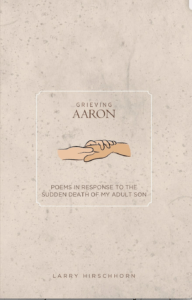
Grieving Aaron
By Larry Hirschorn
Moving and Beautiful Poetry Helps a
Grieving Father, While Keeping His
Beloved Son's Memory Alive
My son Aaron died in a boating accident in March of 2021. He was a vital and beautiful man who left behind a wife, three children, a brother and his parents.
Order Book: Grieving Aaron
When the shock of Aaron's death receded, and I passed through the first intense period of mourning, I felt impelled to write poems that expressed my grief and gave voice to my deepest love for him.
Believe
To believe or not to believe?
If I can’t have that undiscovered country
Where you still live
I will grasp for that other future
Where you took two seconds more to reach the water
And the boat missed you forever
And your skis tipped up and you leaned back with
Outstretched arms and your body was
Beautiful and all our lives were blessed and God was good.
In that imagined country.
The poems in Grieving Aaron are presented in the order in which they were written. The reader can see the ebb and flow of my different experiences in them; bewilderment, yearning, sorrow, anger, concern for my wife, and the stretch to imagine moments of reconciliation.
I had never written serious poetry before and suspect that I will never again. I don’t have a poetic sensibility. While grief can be debilitating, my writing may be one measure of the way in which grief mobilizes our creative impulses. It can help us reach back out into the world to recover some modicum of the love and trust that vanished in the wake of death’s devastation. Surely our sorrow is forever. But I hope that readers experiencing grief will find in my words those threads that connect us back to what is alive and vital. Death has the final word but not the only answer.
Sorrow
I don’t walk across that bridge screaming
Where the air is blood-red and my face is distorted.
I don’t lock the door and close the shades
To watch my shadow sink in the dark.
I don’t drag my feet along the pavement,
My body hugging the apartment walls
So that no one will notice me.
Instead, sorrow is my neighbor, familiar and foreboding
He joins me when I shop for food, pick up the paper
And drop the grandkids at school.
When I work, he waits patiently in the anteroom
For his unscheduled appointment.
He wakens me at night without warning to tell me a secret
I can’t understand.
“Endure me” he whispers, “but I promise you nothing.”
I have to agree. I have no choice.
griefHaven * 310-459-1789 * hope@griefHaven.org
Copyright © 2022 griefHaven aka The Erika Whitmore Godwin Foundation.
All rights reserved.